

You come out of Foodland Kahului and there it is — a crease in the driver’s door that wasn’t there when you went in. Nobody left a note. No witnesses. Just a dent and the frustration that comes with knowing exactly how it happened: someone swung their door open without looking.
It’s the most common type of body damage on Maui, and it’s the one most people put off dealing with. The dent still opens. The car still drives. So it sits there for weeks, then months, while the salt air works its way into every micro-crack in the paint. What starts as a $200 fix becomes a $600 panel repaint because the clear coat failed around the impact point and surface rust set in underneath. Dent removal in Maui is one of the fastest, most affordable services Precision Auto Body offers — and it’s the one that saves people the most money when they don’t wait.
Where Maui Dents Come From (and Why There Are So Many)
Tight parking is the biggest source. The stalls at Queen Ka’ahumanu Center are barely wide enough for a midsize sedan, and when someone parks a lifted truck in the next spot, the geometry doesn’t leave much room to open a door. Costco Kahului is the same story — heavy carts in tight rows on a windy day. Safeway on East Kamehameha, the parking garage at Maui Medical Group on Mahalani, the beach lot at Kalama Park in Kihei — all of them produce a steady stream of door dings, cart dents, and bumper scrapes.
Trade winds add another layer. A gust catches a car door in the Costco lot and swings it into your quarter panel faster than the person holding it can react. Shopping carts roll downhill in the Kihei Safeway lot because the pavement slopes toward the road. Falling coconut fronds in residential Wailuku leave shallow dents that look odd but are structurally harmless — and very fixable.
The common thread is that almost none of these situations involve another driver’s insurance. No collision, no claim, no police report. Just a dent and a decision about whether to fix it now or let it go.
Paintless Dent Repair vs. Conventional Body Work — Which One You Need
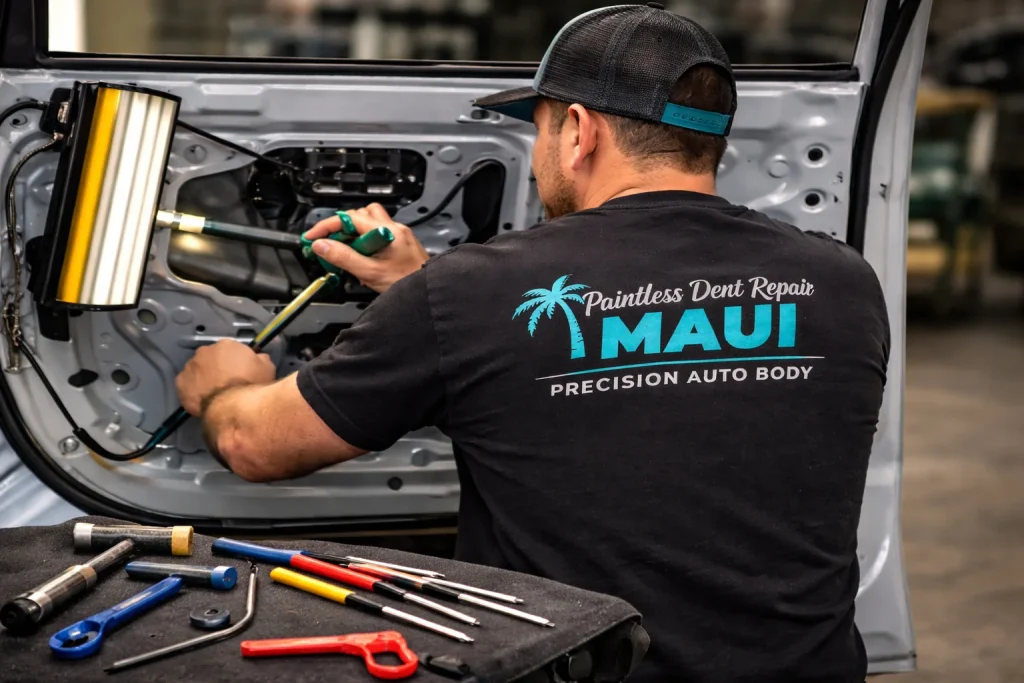
Paintless dent repair — PDR — is the preferred method when the conditions are right. A technician uses specialized tools to work behind the panel and massage the dented metal back into shape from the inside. No filler, no sanding, no repainting. Your factory finish stays intact, the repair is typically done in a few hours, and the cost is significantly less than conventional body work.
PDR works when two conditions are met: the paint surface is still intact with no cracks or chips, and the dent is accessible from behind the panel without removing major components. Most door dings and shallow parking lot dents qualify. The result is a panel that looks and feels original, because it is — no aftermarket paint, no filler, no texture difference.
When PDR won’t work — a deep crease that’s stretched the metal, a dent where the paint has cracked or chipped, or damage in a location that can’t be reached from behind — conventional repair takes over. That means pulling or filling the dent, sanding, priming, color-matching the paint to your vehicle’s factory code, and spraying in a controlled paint booth. It takes longer and costs more, but for damage that’s beyond PDR’s range, it’s the only way to get a clean, lasting result.
Our team assesses every dent individually. There’s no upsell to conventional work when PDR will do the job, and there’s no attempt to PDR something that needs proper bodywork.
When a Dent Is More Than a Dent
Occasionally, what looks like a simple dent reveals something more serious once we take a closer look. A shopping cart hit at speed can crease a door panel and bend the reinforcement bar inside. A parking lot impact that seemed minor can crack the underlying structure of a bumper cover. And any dent near a body line — the sculpted crease that runs along the side of most modern vehicles — is more complex to repair because the metal has been stressed along a precise factory contour.
If a dent turns out to involve structural or mechanical concerns, our team flags it and walks you through the options before proceeding. For damage that crosses into collision repair territory, Precision has the equipment and certifications to handle the full scope under one roof.
Why Waiting Costs More on Maui Than Anywhere Else
This is the part people underestimate. A dent in Phoenix or Portland can sit for a year with minimal consequence because the climate is dry. On Maui, the salt-laden trade winds are constant, and humidity rarely drops below 60%. Every microscopic crack in the paint around a dent is an entry point for moisture. Within months, surface oxidation begins. Within a year, rust can spread under the paint in a halo around the original impact — turning a simple dent repair into a much larger job that requires sanding, rust treatment, body filler, and a full panel repaint.
Fixing a dent while the paint is still intact is always faster, cheaper, and produces a better result than fixing one that’s been left to deteriorate.
Bring It In Before Maui's Air Decides for You
If you’ve got a door ding, a parking lot crease, or a dent that’s been staring at you for too long — bring it in. Precision Auto Body is at 900 Eha Street in Wailuku, open Monday through Friday, 8:00 a.m. to 4:30 p.m. Our team will assess the damage, tell you whether PDR or conventional repair is the right approach, and give you a clear price before any work begins.
Call us at (808) 244-0742 or contact us online to schedule your estimate. Check out our full services page to see everything we handle.
The dent’s not going to fix itself. But on this island, it will get worse.
Frequently Asked Questions About Dent Removal in Maui
How much does dent removal cost on Maui?
Cost depends on the size, depth, and location of the dent, and whether paintless dent repair or conventional bodywork is required. A minor door ding that qualifies for PDR is typically the most affordable auto body service available. Deeper dents or damage that requires repainting cost more. We assess every dent individually and give you a clear estimate before any work starts.
How long does paintless dent repair take?
Most PDR jobs are completed in a few hours — often the same day you bring the vehicle in. Conventional dent repair involving body filler and paint takes longer, typically one to three days depending on the scope. We’ll give you a realistic timeline at the estimate.
Will paintless dent repair damage my factory paint?
No. That’s the primary advantage of PDR — the factory finish stays completely intact. The technician works from behind the panel to reshape the metal without touching the painted surface. No sanding, no filler, no repainting.
Can you fix a dent near a body line or character crease?
Yes, but dents near body lines are more complex because the metal has been factory-pressed into a specific contour. PDR can often handle these, though it requires more skill and time. If the crease has been disrupted beyond what PDR can restore, conventional repair with precision color-matched paint is the alternative.
Should I file an insurance claim for a dent?
For minor dents — door dings, shopping cart damage, small parking lot impacts — the repair cost is often less than a typical deductible, making an out-of-pocket repair more practical. For larger dents involving paint damage or structural concerns, filing a claim may make sense. Precision Auto Body works with all major Hawaii carriers and can help you evaluate the best approach.