

If you’ve owned a car on Maui longer than two years and don’t have a single dent, you’re either driving a rental that gets swapped out twice a year or you’re parking on the moon. Car dents on Maui are so common they’re practically a rite of passage — the first time you find one in your door panel after a beach day at Big Beach is like getting initiated into the club nobody wanted to join.
But there’s a real reason it keeps happening, and there’s a real reason
why letting small dents sit on Maui costs more in the long run than it
does almost anywhere else. Precision Auto Body has been doing car dent
repair in Maui since 1979, and most of what walks through our doors on
Eha Street fits a few predictable patterns. Here’s what’s actually causing
all of it — and what you can do before that small ding turns into a real
problem.
Where Most Maui Dents Come From
The single biggest source of dents we see is parking lots. Specifically,
the doors of other people’s cars. The Costco lot in Kahului. The shopping
center lots in Kihei. The narrow stalls at Queen Ka’ahumanu Center.
Anywhere a tourist who’s used to a giant suburban driveway has to angle a
rented SUV into a stall meant for a regular sedan, you get door-edge
contact with the car next to it.
Second place goes to low-speed rear-end taps. The Dairy Road light. The
Mokulele Highway intersections. The Pi’ilani Highway slowdowns where
visiting drivers don’t quite read the timing of brake lights ahead of
them. These usually look like a clean bumper crease or a rear quarter
panel dent, and most are repairable.
Third — and this one surprises people — is everyday non-collision damage.
Shopping carts in the wind. Coolers loaded into the back. Surfboards and
boogie boards that swing when you grab the wax tube. Garage door clearance
in older homes in Wailuku Heights and Pukalani. None of it is dramatic. All
of it adds up.
Why Maui's Environment Makes Small Dents Worse
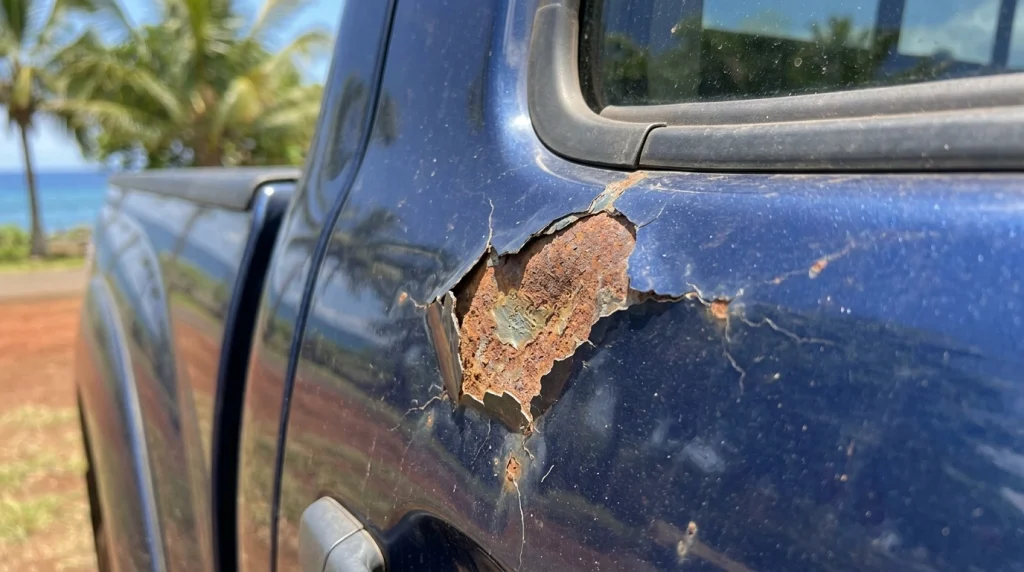
A small dent in Phoenix is mostly a cosmetic problem. A small dent on
Maui is a clock running. Salt air gets into any spot where the paint
surface is broken or stressed — even a hairline paint crack along a dent
edge — and corrosion follows. What was a parking lot ding becomes a rust
spot in eighteen months. What was a rust spot becomes a panel replacement
in two more years.
This isn’t theoretical. We see it constantly. A customer comes in with
what they describe as “a small dent” they’ve been meaning to fix for a
while, and what we’re actually looking at is a dent plus rust pitting
plus paint lifting around the entire edge. The repair is two or three
times what it would’ve been if they’d come in when the damage was fresh.
The roads don’t help, either. The salt air punishes everything, but the
combination of UV intensity, humidity swings, and ocean proximity is what
makes Maui specifically tough on bodywork. Quick repairs stay cheap.
Postponed repairs don’t.
What You Can Actually Do to Reduce Damage
You can’t park-proof your car. Anyone who tells you otherwise is selling
something. But you can stack a few small habits that meaningfully reduce
how often you end up at our shop:
Park at the back of the lot when you can — fewer cars, more space, less
door swing. Avoid the spaces nearest the cart return at any grocery
store, including the Foodland in Kahului and the Times in Kihei. Pay
attention to which side of your car the wind is on when you load and
unload at the beach. Get a clear shield or door edge guards if you’ve got
a vehicle with body panels you’re particularly protective of.
And — most importantly — when damage does happen, don’t wait. We’ve
covered this in detail in our post on common Maui dent scenarios,
but the short version is that the simpler the dent, the simpler the
repair. A door ding that comes in fresh might be a forty-five-minute
paintless dent repair. The same ding three months later, with paint
chipping at the edges and the first signs of rust, is a much bigger job.
When a Dent Is More Than a Dent
Most of what we see is straightforward — pull the dent, restore the
finish, drive away. But every so often a customer comes in thinking
they’ve got a cosmetic issue, and what we find is a panel that’s pushed
in deep enough to have moved underlying structure, or a bumper assembly
that’s hiding sensor or alignment damage behind the surface dent.
That’s why we check more than the dent on every estimate. A
professional dent repair
inspection at our shop looks at the panel, the surrounding panels, the
back side where accessible, and any sensors or hardware that could’ve
been knocked out of spec. If we find anything beyond the cosmetic damage,
we tell you — even if it means the repair is more involved than you
were hoping for.
That’s also why our
collision repair team
exists as a separate operation. Some “dents” are actually collision damage
in disguise. Knowing the difference is the difference between a $400
repair and a $4,000 surprise three months from now.
Get the Small Stuff Fixed Small
The math on dent repair on Maui is simple: today’s small dent is
tomorrow’s medium dent and next year’s big repair. Salt air is patient,
relentless, and unbothered by your schedule. The estimate is free. The
walk-in evaluation takes ten minutes. Most decisions become easier once
you actually know what you’re looking at.
Precision Auto Body is at 900 Eha Street #104 in Wailuku, open Monday
through Friday, 8:00 a.m. to 4:30 p.m. (closed for lunch 12:00 to 12:30).
Call us at (808) 244-0742 or
contact us online.
That dent isn’t going to fix itself. And waiting is the most expensive
thing you can do.
Frequently Asked Questions About Car Dent Repair on Maui
Why are dents so common on Maui?
Three main reasons: tight parking lots with high tourist traffic and
unfamiliar drivers, low-speed congestion at major intersections like Dairy
Road and Pi’ilani Highway, and constant beach and outdoor activity that
results in non-collision damage from shopping carts, coolers, and
boogie boards. Add in the salt air that makes any unrepaired dent worse
over time, and you get a high-volume dent environment.
How long can I leave a dent before it becomes a bigger problem?
Less time than most people think. On Maui, salt air can start
exploiting any compromised paint surface within months, and what was a
straightforward dent can develop rust pitting and paint lifting before a
year is out. Same-week or same-month repair keeps the work simple. Anything
much beyond that and the cost starts climbing.
Can a dent affect my car's resale value?
Yes — and unrepaired dents almost always hurt resale more than a
properly done repair. Buyers and dealers price down for visible damage and
price down further if there’s evidence of paint damage or rust. Quality
dent repair, especially paintless dent repair where applicable, preserves
resale better than ignoring the damage does.
Do you fix dents on rental cars or fleet vehicles?
Yes. We work with private owners, rental agencies, fleet operators, and
commercial vehicles across Maui. Estimates are free regardless of vehicle
type, and we can handle insurance or direct billing depending on the
account.
What if my dent is on a hard-to-access panel?
Some panels — certain quarter panels, structural areas, areas with
sensors or wiring behind them — require conventional repair instead of
paintless dent repair because there’s no way to access the back of the
panel. We tell you at the estimate which approach your specific dent
needs and why. Either way, we handle it in-house at the Wailuku shop.